
The Charity Governance Code provides a practical framework to help charities strengthen governance and operate effectively. While it’s not law or a regulatory requirement, it serves as an aspirational benchmark and a valuable starting point for assessing governance practices.
The code adopts an apply or explain principle, encouraging charities to adopt its recommendations or explain why they haven’t. This flexible approach recognises the diversity of charities and acknowledges that not all principles will suit every organisation, particularly smaller or uniquely structured ones. Rather than a rigid checklist, the code should be viewed as a tool for continuous improvement, supporting transparency and accountability.
Although voluntary, applying its principles can reassure stakeholders about governance standards. You can download the full Charity Governance Code from the Code website.
What has changed?
The updated Charity Governance Code, released in November 2025, offers a more practical, accessible framework to strengthen governance and help boards ask better questions. While the changes are evolutionary, they reflect a modern, inclusive approach that supports continuous improvement.
The code retains eight universal principles, now with clearer indicators to assess effectiveness, alongside suggested policies, processes, and evidence examples.
Key updates include new and reframed principles:
- Foundation: Emphasises trustees’ legal duties, understanding of governing documents, and commitment to ongoing learning.
- Ethics and culture: Combines the former Integrity and Openness & Accountability principles, placing values at the heart of governance.
- Decision making and managing resources and risks: Previously one principle, now split for more focused board discussions.
- Equality, diversity & inclusion: Expands the former Diversity principle to promote a broader, more thoughtful approach.
The code also introduces themes such as environmental responsibility, digital governance, learning culture, and transparent reporting.
A summary of each of the principles
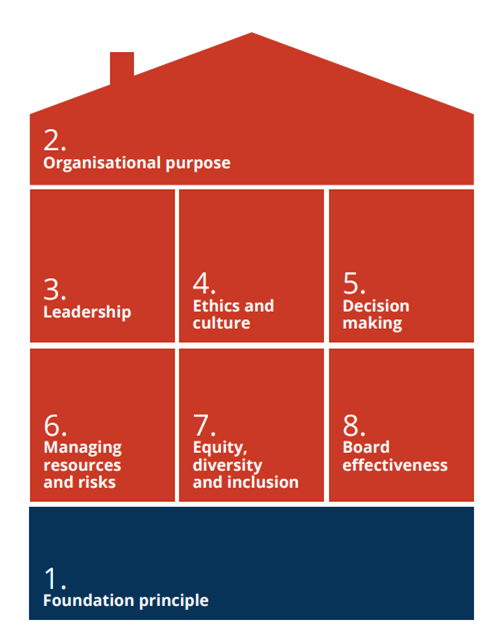
1. Foundation principle
- Trustees hold ultimate responsibility for the charity and must understand their role, legal duties, and the organisation they serve.
- Effective governance means trustees commit time, maintain continuous learning, and understand the governing document, purposes, and public benefit.
- They stay up to date with charity law, uphold high standards, and manage conflicts of interest, putting the charity’s aims first.
Key behaviours: Trustees prioritise induction, stay informed, share expertise, maintain confidentiality and declare conflicts.
Policies and practices: Clear induction covering duties and organisational context; explicit expectations on time and conduct; and implementation of conflict of interest policy.
Evidence: Role descriptions, induction checklists, governing documents, conflicts register, codes of conduct and attendance records.
2. Organisational purpose
- Boards must be clear about aims and public benefit, aligning activities now and for the future.
- Good governance means prioritising beneficiaries, setting short and long-term objectives, measuring impact and adapting to change.
Key behaviours: Focus on mission-critical issues, balance stakeholder evidence, think forward, review new activities for compatibility and reflect on relevance.
Policies and practices: Regular reviews of external changes; stakeholder involvement in vision and strategy; and clear objectives with monitoring.
Evidence: Vision and strategy documents, KPIs, trustee reports, stakeholder feedback, and impact measures.
3. Leadership
- Boards provide strategic leadership aligned with purpose and values.
- Trustees respect defined roles, distinguish governance from operational tasks, and foster collaboration.
Key behaviours: Champion values, act respectfully, question ideas, take ambassadorial roles and maintain cohesion.
Policies and practices: Define values, clarify roles, fair chair appointment, review dynamics, and appraisal processes.
Evidence: Codes of conduct, role descriptions, strategy documents and appraisal records.
4. Ethics and culture
- Boards set standards shaping behaviour and culture, ensuring openness and responsiveness.
- Trustees model values, adopt clear standards, and consider ethical, social, and environmental impacts.
- Complaints are handled fairly and used for learning.
Key behaviours: Lead by example, uphold ethics, foster respect, speak up, and learn from mistakes.
Policies and practices: Align culture with values; maintain ethics, safeguarding, complaints, and whistleblowing policies; publish guidance for concerns; and conduct due diligence.
Evidence: Codes of conduct, policy summaries, stakeholder feedback, complaints reporting, and trustee training.
5. Decision making
- An effective board makes timely, well-informed decisions that serve the charity’s purpose.
- Trustees take responsibility for considering decisions carefully and working towards consensus.
- Good governance means clarity on which decisions are reserved for the board, meetings focus on strategic priorities, and trustees have the information needed to make sound choices.
- Boards review past performance to learn and track decisions for accountability.
Key behaviours: Trustees respect delegated roles, question information constructively, seek advice when needed, and share collective accountability. They engage in open debate and progress discussions towards solutions. Committee chairs work closely with the board chair for integrated decision-making.
Policies and practices: Maintain a clear scheme of delegation, define matters reserved for board approval, and design agendas around strategic issues. Ensure secure access to papers, set escalation rules, and review delegation regularly. Committees operate within defined scopes and feed into board decisions effectively.
Evidence: Schemes of delegation, board minutes, agendas, KPIs, and documented decision-making processes.
6. Managing risk and resources
- The board stewards resources and manages risks to achieve the charity’s aims.
- Trustees understand capabilities, optimise resources, assess sustainability, and balance risk-taking with safeguarding people and assets.
- Robust control and risk frameworks are reviewed regularly.
Key behaviours: Trustees understand finances, ask questions, use data, maximise assets responsibly, and address risks proactively.
Policies and practices: Approve budgets aligned with strategy, monitor income sustainability, review major risks, agree risk tolerances, and maintain reserves policy. Larger charities oversee subsidiaries and investment strategies.
Evidence: Financial reports, risk registers, reserves policy, annual accounts, audit letters, and internal controls.
7. Equality, diversity and inclusion (EDI)
- Boards embed EDI across the organisation and their own practices.
- Trustees create inclusive environments, understand inequality, and set clear EDI objectives with plans and monitoring.
- Diverse perspectives strengthen decision-making.
Key behaviours: Trustees value diverse opinions, consider absent voices, and act swiftly on inappropriate behaviour.
Policies and practices: Define why EDI matters, engage stakeholders, allocate resources, monitor progress, and share successes and challenges.
Evidence: EDI strategies, feedback surveys, progress reports, and learning records.
8. Board effectiveness
- Boards combine the right mix of skills and perspectives, work cohesively, and review performance regularly.
- Recruitment is transparent, induction and development are ongoing, and feedback mechanisms are clear.
Key behaviours: Trustees engage beyond meetings, respect procedures, and give and receive feedback constructively.
Policies and practices: Map skills, advertise vacancies, appoint on merit, plan succession, and review performance annually.
Evidence: Skills audits, recruitment policies, succession plans, appraisal records, and development budgets.
We’re here to help
Boards should regularly review how they apply the Charity Governance Code, and with the recent update, now would be a good time that the revised version is considered by Trustee Boards.
If you’d like further guidance, a governance review, or tailored trustee training on this topic, please contact a member of our specialist team or speak to your usual adviser.