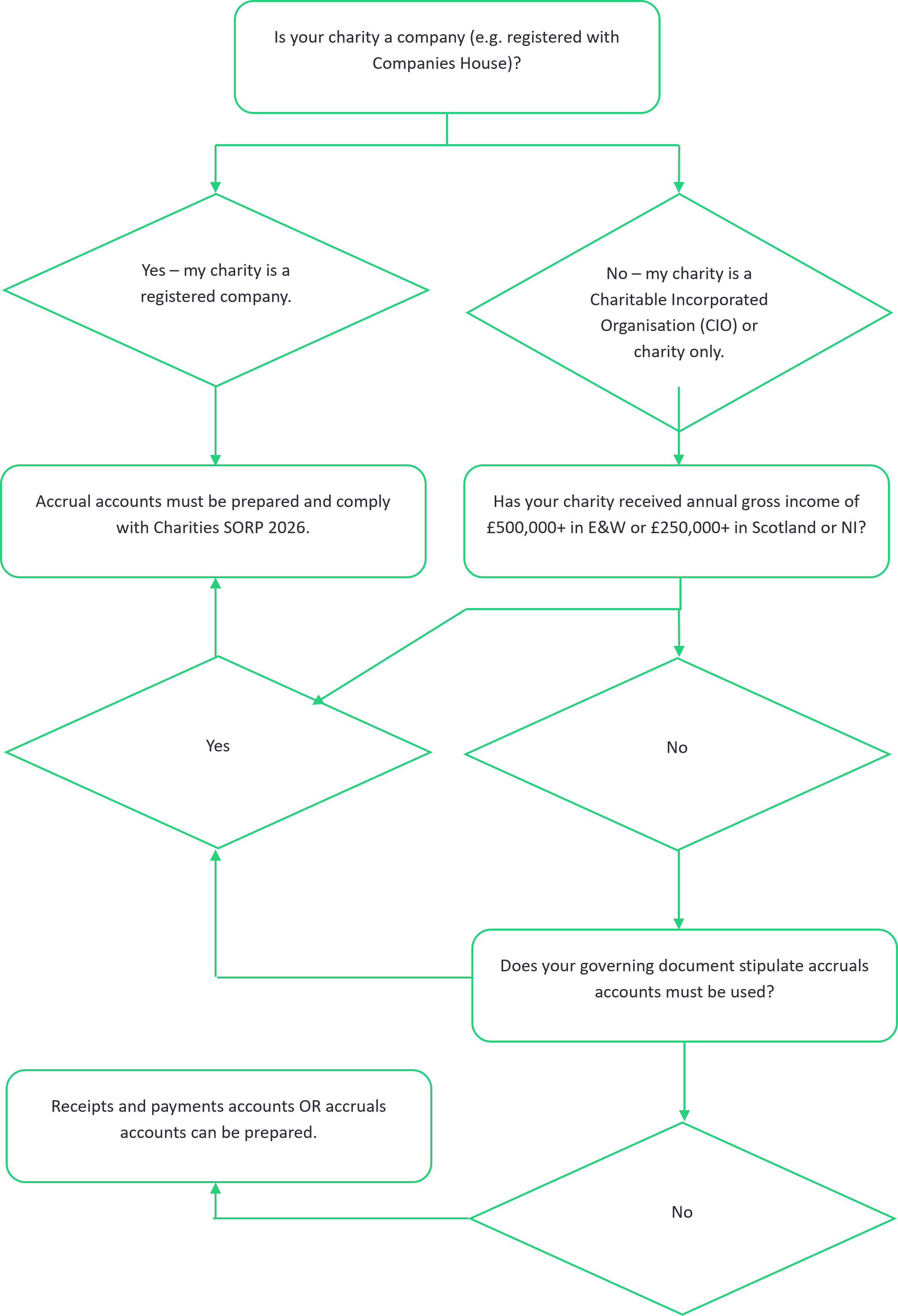
Accruals vs. Receipts & payments accounts
If your charity is registered in England and Wales (E&W) only, from 30 September 2026, the income level for preparing different types of accounts is due to change. The threshold for preparing receipts and payments accounts is increasing from gross income up to £250,000 to £500,000. This will mean that more charities will have a choice in the format of their financial statements. The level will remain at £250,000 in Northern Ireland (CCNI) and under the Scottish Regulator (OSCR).
What are accruals accounts?
Accruals accounts (also called accrued accounts) are financial statements prepared on the accruals basis of accounting, meaning income and expenditure are recorded when they are earned or incurred, not when cash is received or paid. Accruals accounts show the true financial position and performance of an organisation for a period (e.g. money that is owed to or from a charity), rather than just its cash movements.
The accruals accounts include:
- Trustees’ annual report
- Statement of Financial Activities (SoFA)
- Balance sheet
- Notes to the accounts
The account must comply with the Charities Statement of Recommended Practice (Charities SORP).
What are receipts and payments accounts?
Receipts and payments (R&P) accounts are a simple form of charity accounts that record actual cash received and cash paid out during the financial year. They are designed for smaller, non‑complex charities. Income and expenditure is recorded when cash is received or paid. There are no adjustments for liabilities or debtors, or recognising income or costs in another year.
Receipts and payments accounts include:
- Trustees’ annual report
- Receipts and payments statement (a summary of cash in and out)
- Statement of balances (assets and liabilities)
- Notes explaining key items
Unlike accruals accounts, R&P accounts do not comply with the Charities SORP.
How do I know which accounts to prepare?