
Attracting, retaining and rewarding key employees remains a priority for many growing businesses, but increasing salaries and cash bonuses is not always the only answer.
The Autumn Budget 2026 announced significant changes to the Company Share Option Plan (CSOP), including its rebranding as Enterprise Management Incentives 2 (EMI2). The changes are designed to strengthen its role as both a complement to Enterprise Management Incentives (EMI) and an option for businesses that have outgrown EMI or are unable to qualify for it.
For business owners and employers, this creates a useful opportunity to revisit existing employee incentive arrangements and consider whether tax-advantaged share options could play a greater role in their future reward and retention strategy.
What is changing for EMI2 and CSOP options?
Although the scheme will continue to be known as CSOP in legislation, it has been rebranded as EMI2 from 28 October 2026. The more substantial changes take effect from 6 April 2027.
A higher individual limit
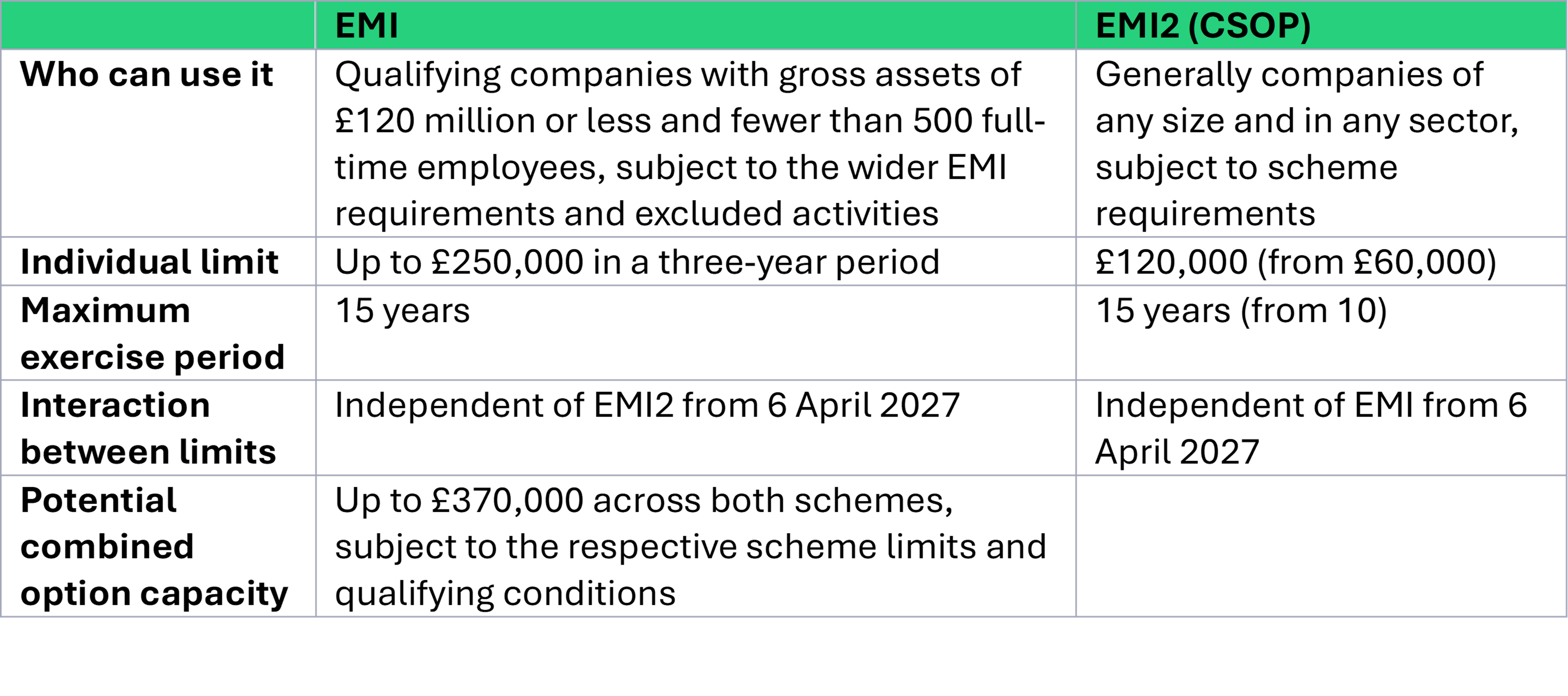
The maximum value of shares over which an employee can hold EMI2 options will double from £60,000 to £120,000, based on their market value when the options are granted.
The increase could enable employers to offer more meaningful awards to key employees, making EMI2 potentially more useful as part of a wider remuneration and retention package.
EMI and EMI2 will operate independently
One of the most significant changes concerns the interaction between EMI and EMI2. Currently, CSOP options count towards an employee's £250,000 EMI individual limit. From 6 April 2027, that interaction will be removed.
Where the relevant conditions are satisfied, an employee could therefore potentially hold up to £250,000 of EMI options, subject to the EMI rules, and a further £120,000 of EMI2 options, creating potential combined tax-advantaged option capacity of up to £370,000, subject to the respective limits and qualifying conditions.
For businesses already operating an EMI scheme, this could make EMI2 valuable as a complementary incentive rather than simply an alternative to EMI.
More time to exercise options
The maximum period for exercising EMI2 options while retaining the scheme's tax advantages will increase from 10 years to 15 years, bringing it into line with EMI. This could provide greater flexibility for businesses with longer growth or exit horizons.
Importantly, existing CSOP option agreements in place before 6 April 2027 can be amended to benefit from the 15-year maximum exercise period without losing the scheme's tax advantages, provided the amendment complies with the legislation.
EMI vs EMI2: how do the schemes compare from April 2027?
Who could benefit from EMI2?
Businesses that cannot use EMI. If your activities do not qualify for EMI, or you have grown beyond its eligibility requirements, revisit whether the enhanced EMI2 regime now offers a more attractive viable tax-advantaged alternative. Businesses that previously discounted CSOP because of the £60,000 limit should check whether the £120,000 allowance changes the commercial case.
Businesses already using EMI. For businesses already operating EMI, EMI2 could provide additional flexibility when designing future incentive packages, particularly given the combined option capacity above from 6 April 2027. This may be particularly relevant where businesses want to provide additional awards to key people while continuing to benefit from existing EMI schemes in place.
Businesses considering employee share incentives for the first time. The changes also provide a useful reason for businesses without an existing share scheme to consider whether employee ownership could support their recruitment, retention and growth objectives. The right arrangement will depend on the business, employees and longer-term ownership plans, rather than the tax advantages alone.
What should businesses consider now?
1. Review existing employee incentive arrangements
Consider whether existing share plans and other remuneration arrangements continue to support your recruitment, retention and succession objectives. For businesses with older EMI arrangements, this review may also need to consider the separate extension of the EMI option exercise period from 10 to 15 years. Our earlier article, “EMI scheme options approaching 10 years? The new 15-year limit could change your next steps”, explains the considerations for businesses with existing EMI options approaching their original expiry date.
2. Revisit EMI2 if EMI is unavailable
If you previously ruled out EMI2 because of the CSOP limits or because your business could not qualify for EMI, reconsider whether the enhanced regime changes the position.
3. Consider how options fit your wider ownership strategy
The tax treatment is only one consideration. Businesses should think about who should participate, the type of shares involved, appropriate performance or vesting conditions and how the arrangements align with future growth, succession or exit plans. For businesses with more complex or international arrangements, the review may also need to consider whether alternative employee incentive structures would better support the company's objectives.
4. Review existing CSOP documentation
Businesses with existing CSOP arrangements should review plan documentation, outstanding awards and employee communications ahead of April 2027 to understand where the new rules create opportunities or require changes.
In particular, existing option agreements may potentially be amended to benefit from the new 15-year exercise period, to delay potentially cancelling and re-issuing options, and preserving the existing exercise price, provided the company continues to qualify under the legislative criteria .
We’re here to help
Our share schemes specialists can help you review existing arrangements, assess whether EMI or EMI2 could be appropriate and consider how share incentives could support your recruitment, retention, succession and growth objectives.
Whether you already operate EMI or CSOP, have previously been unable to use EMI, or are considering employee share incentives for the first time, speak to your usual Azets adviser or a member of our specialist team to explore the options available.